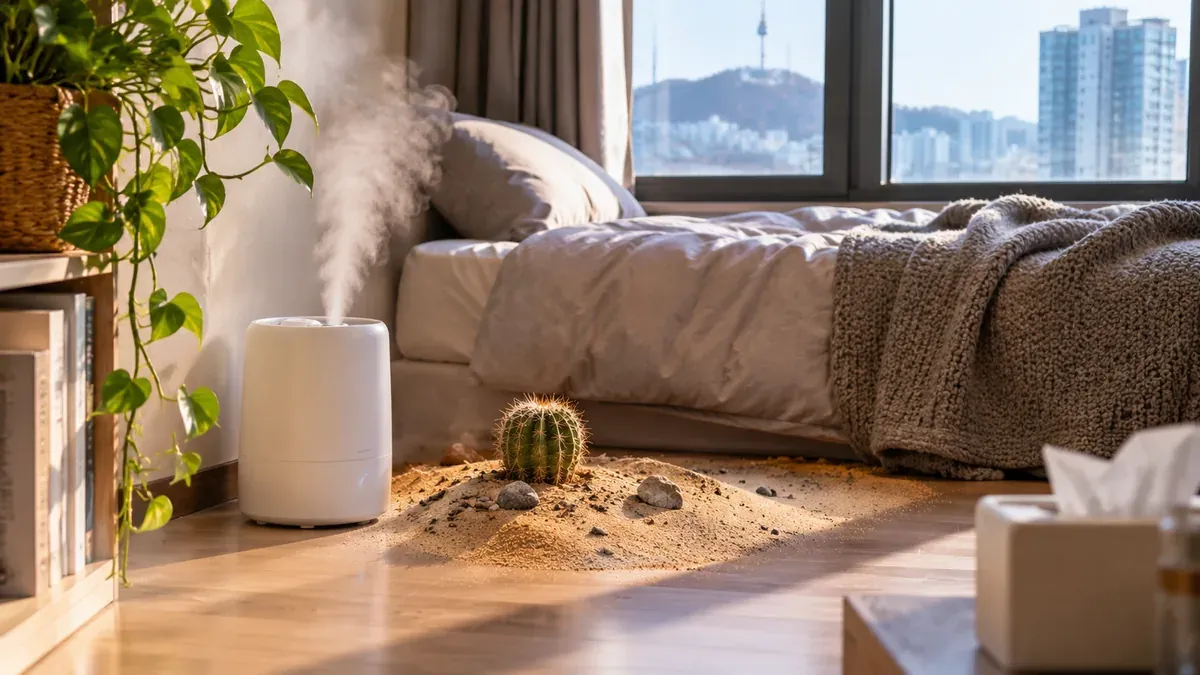
Dry indoor air during a Korean winter can be uncomfortable, but buying the biggest humidifier is not always the answer. Choose one that suits your room, is simple to clean, and allows you to control humidity without causing condensation.
What types of humidifier can you buy in Korea?
| Type | Korean search term | Main advantage | Trade-off |
|---|---|---|---|
| Evaporative | 기화식 가습기 | Lower mineral dispersal than ultrasonic units | Fan noise and possible filter costs |
| Ultrasonic | 초음파식 가습기 | Low electricity use and often quiet | More attention to water minerals and tank hygiene |
| Heated/steam | 가열식 가습기 | Strong moisture output in some models | Hot steam, burn risk and energy consumption |
| Hybrid | 복합식 가습기 | Combines operating approaches | Check which mode is in use and how it is cleaned |
The Korea Consumer Agency’s 2025 comparison of 13 humidifiers found a 3.3-fold difference in output and more than a 40-fold difference in estimated annual operating and maintenance costs among the tested products. The agency recommends choosing by room size, humidification method, noise and operating costs rather than tank size alone.
Which Korean humidifier models are useful comparisons?
These are tested examples, not an updated 2026 shopping ranking. Current availability and prices have not been verified.
- Xiaomi CJSJSQ02XYKRA (evaporative): Tested output of 433 mL/hour and a test-based humidification area of approximately 30.5 m². Check filter supply and cleaning instructions before buying.
- Cuckoo CH-GS301FW (ultrasonic): A 3.8-litre model. The agency reported ₩4,640 in estimated annual operating and maintenance cost under its specified usage assumptions, not total ownership cost under every usage pattern.
- Lezen LZHD-H85 (heated): Tested output of 499 mL/hour and a test-based area of 35.2 m². Keep it away from children because of hot water and steam.
You can compare all models and the test methodology in the Korean consumer agency’s original product tables. Exact model suffixes may vary between listings, so match the specification rather than the brand alone.
Where can you buy a humidifier in Korea?
Use 가습기 (humidifier), 세척 편한 가습기 (easy-to-clean humidifier) or a type-specific term in Korean shopping searches. Compare manufacturer cleaning instructions, replacement-filter prices, automatic shutoff and returns before paying.
If you are newly arrived and having trouble with Korean checkout or deliveries, see EEIK’s guide to getting deliveries before you have an ARC or Korean bank card. For used household equipment, the guide to English-friendly Seoul buy-and-sell groups offers another route. Avoid secondhand machines with visible contamination or parts that cannot be cleaned properly.
What humidity level is reasonable during a Korean winter?
Measure the air with a hygrometer (습도계) rather than guessing. The US EPA’s indoor-air guidance gives a general indoor range of 30% to 50% relative humidity. It also advises keeping humidifier-driven humidity at or below 50% to limit moisture-related problems.
This matters to EEIK members. In a December 2024 discussion about morning throat and nose dryness despite 40% humidity, a member wondered why a humidifier had not solved their symptoms. A single 40% reading does not establish the cause of a dry throat. More moisture may not be appropriate if humidity is already in a typical range. If symptoms persist, seek medical advice rather than endlessly increasing the setting.
Dry winter air has been a recurring topic in the Every Expat in Korea Facebook Group for years. Back in November 2021, a member asked how to stop waking up with a very dry nose. The question drew 53 comments. If you have the same problem, take a look at that winter-dryness discussion and see what other members had to say.
Is an air purifier the same thing as a humidifier?
No. A humidifier (가습기) adds moisture, a dehumidifier (제습기) removes moisture and an air purifier (공기청정기) is primarily designed to filter airborne particles. Some combination appliances have more than one function; check the specific model.
A member in our Every Expat in Korea Facebook Group raised a similar question in June 2025 after using a Coway appliance in a 30 m² flat. They felt it was not helping with humidity and wondered why the room seemed warmer. Read their question about air purifiers and humidity. The experience is a good reminder to check what a particular appliance actually does; it is not a measured performance test of that model.
How should you clean and use a humidifier safely?
The EPA’s home-humidifier care guidance recommends emptying, drying and refilling portable units daily, and cleaning them every three days. Follow the manufacturer’s instructions for cleaning agents and rinse them thoroughly. For ultrasonic units, low-mineral water can help limit mineral dispersal into indoor air.
Keep the floor, windows and surrounding furniture dry. Reduce output if you see condensation. Heated models must be kept out of children’s reach. Do not add household disinfectants or fragrances to the operating water unless the manufacturer explicitly approves that use.
What should you check before buying?
Compare your room’s approximate size with verified model performance. Check the noise level for overnight use, whether filters are easy to obtain in Korea, whether the water tank can be scrubbed, and the current return and warranty terms. Treat historical test prices as references rather than today’s sale prices.
Before you buy: Do your own checks on the exact model, current Korean pricing, safety features, cleaning requirements and warranty. Our comparisons are a starting point, not a personal product endorsement. If dryness or breathing symptoms persist even when your room humidity is in a normal range, speak with a qualified healthcare professional rather than assuming a humidifier will solve the problem.
What have other expats in Korea asked about winter dryness?
Humidifiers and winter air have come up several times in the Every Expat in Korea Facebook Group. These older conversations might be useful if you’re comparing experiences with your own apartment:
- How do you stop an apartment getting so dry in winter? A November 2021 question about waking up with a dry nose, with 53 comments.
- Why do I still feel dry when my room reads 40% humidity? A December 2024 question from someone already using a humidifier, with 38 comments.
- Is this air purifier supposed to help with humidity? A June 2025 question about a Coway appliance in a 30 m² flat, with 20 comments.
Your experience may differ depending on room size, ventilation, heating and the type of humidifier. If you’ve found a model that’s easy to clean and works well through a Korean winter, join the conversation and share what you’ve learned.
Which sources support these recommendations?
- Korea Consumer Agency: 2025 humidifier comparison, published October 30, 2025.
- KDI archive of the Korea Consumer Agency’s detailed findings, published October 31, 2025.
- US EPA: Use and Care of Home Humidifiers.
- US EPA: Care for Your Air, indoor humidity guidance.