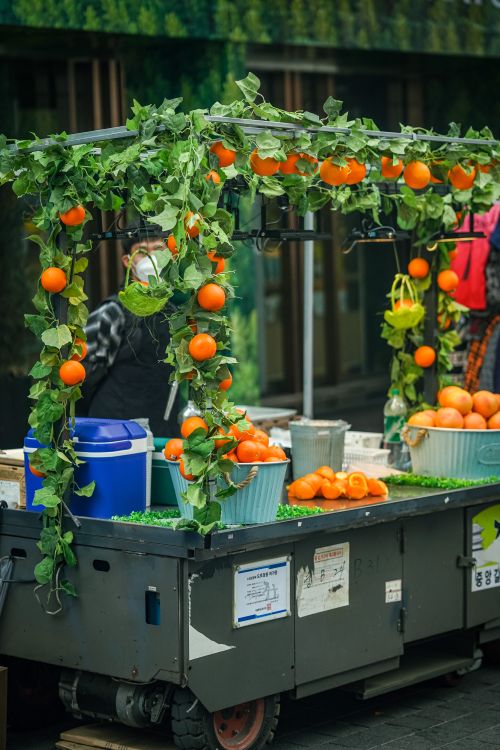
Fruit shopping in Seoul can feel like a guessing game. One stall has bargain tangerines, another offers an apple promotion, and a beautifully wrapped fruit gift set costs more than dinner. The best strategy is understanding which fruit is in season, which shops compete on price and how much you actually need. Strawberry and raspberry questions are part of the story, not the whole story.
Market photograph: Nuhyil Ahammed / Pexels. The fruit is real; a universally cheap fruit shop would be the real fantasy.
Where should you shop for cheaper fruit in Seoul?
Start with a neighborhood fruit shop (과일가게) or traditional market (전통시장), then compare prices at a larger supermarket. There is no reliable citywide winner for every fruit and every week.
If you want a dedicated produce-shopping destination, these three are good starting points. The Mangwon strip described below is a fourth option:
| Place | Why go | Trade-off |
|---|---|---|
| Garak Mall / Garak Market (가락몰 / 가락시장) in Songpa | Large produce selection and retail-oriented sales buildings attached to the wholesale market | Some wholesale activity favors box quantities; use the retail area for everyday shopping |
| Cheongnyangni Fruit & Vegetable Market (청량리청과물시장) in Dongdaemun | Lots of produce sellers concentrated in one area, making comparisons easier | Large boxes and bundles are common, so ask if smaller quantities are sold |
| Gyeongdong Market (경동시장) near Jegi-dong | Produce alongside an enormous traditional market for groceries and herbs | Not every seller specializes in fruit; inspect quality and compare stalls |
The Official Seoul Travel Guide confirms Garak Mall’s retail food sales areas. It also describes Gyeongdong Market as a major agricultural market, and a recent local news report highlights fruit shopping around Cheongnyangni.
These are places to compare, not claims that a particular stall has today’s cheapest strawberries.
Are traditional markets actually cheaper than marts?
Not always. Seoul publishes a market-versus-supermarket price comparison, and its November 2026 averages make the point clearly.
| Fruit and unit | Traditional market average | Large mart average |
|---|---|---|
| Jeju tangerines, 10 | ₩4,503 | ₩5,270 |
| Shine Muscat grapes, 2 kg | ₩10,404 | ₩12,362 |
| Fuji apples, each | ₩2,166 | ₩1,917 |
| Korean pears, each | ₩3,332 | ₩2,570 |
| Strawberries, 500 g | ₩20,167 | ₩19,887 |
Source: Seoul City price-information comparison, November 2026. These are surveyed averages, not live prices, and actual quality, size, promotions and availability can differ.
So if you’re buying grapes or tangerines, a market might win. For some apples, pears or early strawberries, the supermarket might win instead. Check the size of the pack and the price per 100 g or kilogram, not just the sticker on the front.
A useful habit is to compare two stalls before committing to a box, especially when fruit is very ripe or sold as a discount bundle.
What if you live in Gangnam or somewhere without a market nearby?
Start locally before making a cross-city trip. On Naver Map or Kakao Map, search:
- 과일가게: fruit shop
- 청과물: fruit and produce shop
- 전통시장: traditional market
- 농산물: agricultural produce
- 가락몰: Garak Mall
Small neighborhood fruit shops sometimes offer good-value bags of seasonal fruit, especially when they need to sell ripe stock quickly. A large supermarket may be better when a particular item is on promotion.
Delivery from Coupang, Kurly, Oasis or SSG can be convenient, but compare the same weight, shipping threshold and quality grade. Buying a cheap oversized box only makes sense if you’ll actually finish it.
In a March 2025 EEIK discussion, a member living in a residential part of Gangnam asked where to buy affordable fresh meat, vegetables and fruit, saying nearby options were mainly cafes and convenience stores. The discussion attracted 32 comments, although we haven’t checked those replies or treated them as verified shop recommendations. The question illustrates the real problem: finding a useful produce shop close to home, not just knowing the name of a famous market.
A local fruit-shopping lead: Mangwon Station Exit 2
One overlooked shopping area is Mangwon’s fruit-shop strip (망원역 청과물 거리) near Mangwon Station Exit 2. A July 2025 Korean-language field report found a watermelon offered around ₩19,000, compared with a national average around ₩30,884 at the time. Another shopper described a ₩5,000 basket of plums. These are dated anecdotes, not today’s prices.
The more useful detail is how the bargains arise. Produce shops cluster together and sellers in the report described sourcing directly, competing on price and moving larger volumes. Walk the strip and compare several stalls instead of assuming the first price is the best.
Fruit in season in Korea: calendar and price references
Korean fruit seasons differ from familiar Western expectations. Greenhouse crops, storage and imports extend availability, so the months below refer to the main Korean supply window, not the only months a fruit can be purchased.
| Fruit (Korean) | Main local season | Published price reference | Practical tip |
|---|---|---|---|
| Strawberries (딸기) | Dec-Apr | Approx. ₩9,935 per 500 g, derived from a Feb 13, 2026 national price of ₩1,987 per 100 g | Early November 2026 Seoul surveys were much higher, around ₩20,000 per 500 g |
| Jeju mandarins (귤) | Oct-Feb | ₩4,503 for 10 at Seoul markets, Nov 2026 | Compare small vs large fruit and check ripeness |
| Late-season citrus (한라봉 / 만감류) | Jan-Mar | No comparable seasonal retail reference verified | Different citrus cultivars have different prices |
| Korean melon (참외) | Apr-Jul | ₩16,700 for 10, national Aug 7, 2026 reference | The August figure is at the tail of the main season |
| Watermelon (수박) | Jun-Aug | ₩24,467 per melon, national Aug 7, 2026 reference | Compare size and weight, not just whole-fruit price |
| Peaches (복숭아) | Jun-Sep | ₩18,602 for 10, national Aug 7, 2026 reference | Yellow and white varieties vary; soft fruit has a short shelf life |
| Plums (자두) | Jun-Sep | ₩5,000 per basket, one Mangwon 2025 shopping report | Anecdote only: the basket’s weight wasn’t standardized |
| Shine Muscat grapes (샤인머스켓) | Aug-Oct | ₩10,404 per 2 kg, Seoul markets, Nov 2026 | Check net weight, cultivar and grape firmness |
| Apples (사과) | Sep-Nov, stored longer | ₩1,917 per Fuji apple, Seoul marts, Nov 2026 | Aori, Hongro and Fuji have different seasons and prices |
| Korean pears (배) | Aug-Oct, stored longer | ₩2,570 per Shingo pear, Seoul marts, Nov 2026 | Ordinary home-use pears differ from premium gift pears |
| Sweet persimmons (단감) | Oct-Dec | ₩872 each, Seoul marts, Nov 2026 | Crunchy 단감 is different from soft 홍시 |
| Domestic kiwi (참다래) | Nov-Mar | No date-matched retail reference verified | Imported kiwis can be available year-round |
| Figs (무화과) | Aug-Oct | No comparable retail reference verified | Buy only what you can eat soon |
How to read the numbers: The Seoul figures come from the city’s November 2026 traditional-market versus large-mart survey. February and August references come from published aT KAMIS retail-price data and a dated 2026 summary. The plum example is one shopper’s 2025 experience, not a market average. Different dates, grades, seasons and units mean these prices must not be treated as a single standardized price survey or guaranteed seasonal lows.*
A Korean five-year seasonality analysis identifies commonly lower-priced periods around late April for strawberries, late June for watermelon, early July for chamoe, late July for white peaches and November for several autumn fruits. The historical pattern is useful for planning, but harvest weather can shift the best week.
Lesser-known tricks from Korean fruit shopping
Mangwon’s fruit strip is not the same as buying from the first tourist-market stall. Look around Mangwon Station Exit 2, where several merchants compete directly. The 2025 report described vendors’ price competition rather than guaranteeing every sale is a bargain.
Cheongnyangni sometimes marks fruit down after 4 p.m. In one Korean-language report, a vendor reduced a box of peaches from ₩10,000 to ₩8,000. A 2026 three-week market observation likewise saw price labels change near closing. Late shopping can help, but expect fewer choices and inspect fruit carefully. Early shopping may be better for selection.
Know the difference between retail and auction prices. Ordinary shoppers at Garak Mall purchase from retailers; headline wholesale auction quotations refer to other quantities, grades and sales channels. Seoul’s fruit-market feature describes Garak’s retail fruit area and premium mixed gift baskets around ₩80,000 to ₩100,000. Gift-grade fruit and everyday fruit serve different buyers.
Look for 가정용 and 못난이 / 흠과. These mean home-use and cosmetically imperfect fruit. They can help you avoid gift-grade premiums, but ask about condition and inspect lower layers for bruising or mold.
A basket isn’t a kilogram. Market signs may quote 한 봉지 (bag), 한 바구니 (basket) or 한 박스 (box). Ask 킬로당 얼마예요? (How much per kilogram?) before declaring a bargain. Check whether prices describe one fruit or the whole lot.
Holiday presentation changes the price. Before Seollal and Chuseok, apples and pears may be sold in carefully selected gift boxes. Comparing those with loose apples or pears is misleading, even when the fruit name is the same.
When is strawberry season in Korea?
South Korea’s main commercial strawberry season is generally winter through early spring. You may see early greenhouse strawberries in November or December, with a wider supply often available from December through April and sometimes May, depending on the crop.
Strawberry season and cheapest strawberry season are not identical. Early packs can be expensive; prices may ease when more farms are harvesting, but weather and promotions matter.
Look for 딸기 (strawberries) on price tags and compare the pack weight. A bigger punnet isn’t automatically better value if the fruit is bruised or won’t last.
Can you find fresh raspberries during strawberry season?
Sometimes, but don’t count on it. Korean supermarkets sell strawberries much more routinely than fresh raspberries. Strawberry season in Korea does not create an equivalent local fresh-raspberry season.
For fresh raspberries, try searching 생라즈베리 (fresh raspberries) or 라즈베리 생과 (fresh raspberry fruit) in Korean grocery apps and ask specialist fruit sellers whether they can source a pack. We could not confirm a consistently stocked fresh-raspberry seller in Seoul, so we would not send you to a particular store with a promise.
For baking, smoothies or desserts, 냉동 라즈베리 (frozen raspberries) is considerably easier to source. Korean grocery retailers including Kurly, Oasis and SSG/Emart show frozen raspberry or mixed-berry listings. Check current stock, delivery area and whether a mixed pack contains enough raspberries for your recipe.
Also note that 복분자 usually refers to Korean black raspberry, which is a different fruit from the familiar red raspberry sold as 라즈베리. If you need red raspberries, be specific.
How to avoid paying more than you need to
- Check the season: Seasonal Korean fruit is often easier to find at competitive prices than imported specialty berries.
- Compare unit prices: A ₩5,000 bag may not beat a ₩7,000 pack if the weights are different.
- Inspect discounted boxes: Check underneath for bruising and spoilage.
- Factor in travel: A good deal disappears if you spend an hour and two subway fares chasing it.
- Buy for your actual household: A half-priced box isn’t a bargain if half ends up in the bin.
Useful Korean phrases
- 딸기 얼마예요? : How much are the strawberries?
- 이거 한 팩에 얼마예요? : How much is one pack?
- 조금만 살 수 있어요? : Can I buy a smaller amount?
- 생라즈베리 있어요? : Do you have fresh raspberries?
- 냉동 말고 생과일 찾고 있어요. : I’m looking for fresh fruit, not frozen.
- 오늘 할인하는 과일 있어요? : Is any fruit discounted today?
Bottom line
For cheaper everyday fruit in Seoul, compare your local produce shop with nearby traditional markets and supermarkets before travelling far. Garak Mall, Cheongnyangni and Gyeongdong are worthwhile options when you want variety or enough fruit to justify a dedicated trip.
For strawberries, keep an eye out from late autumn as the winter harvest builds. For fresh red raspberries, be prepared for an uncertain search; frozen berries are the more dependable fallback. Prices and stock can change quickly, so verify before setting out.