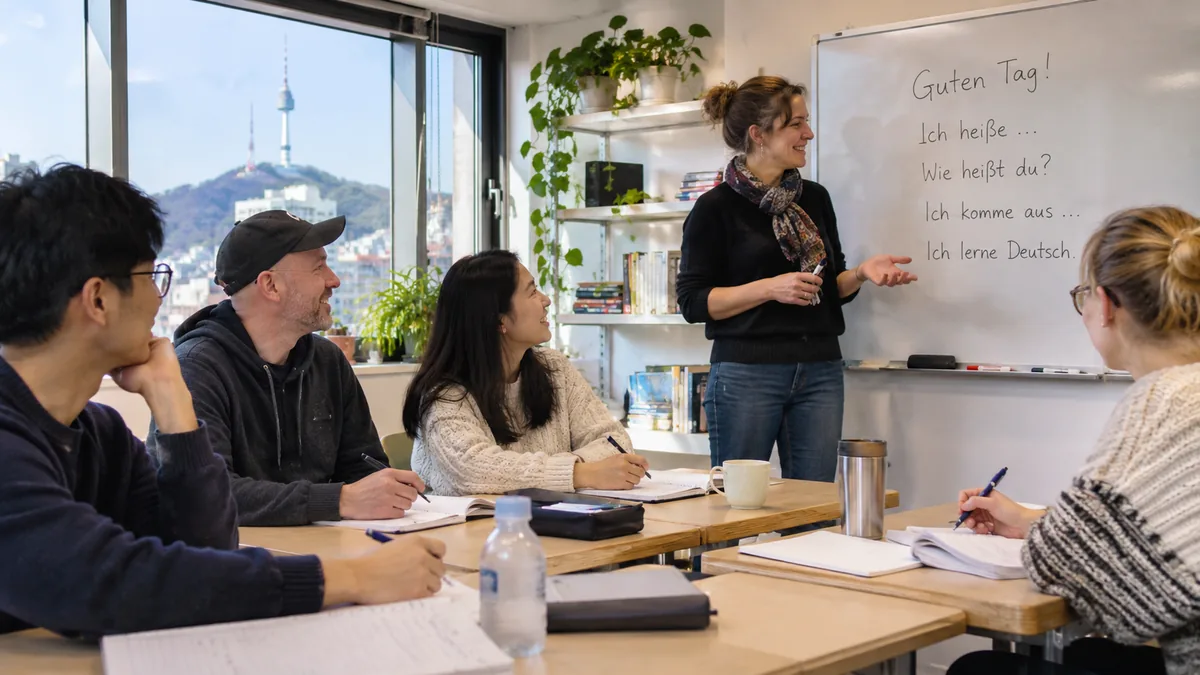
If you’re starting German from scratch while living in Korea, Goethe-Institut in Yongsan is one of the most straightforward places to investigate. It offers structured classes, a clear beginner starting level and internationally recognised language exams. But there are a few things worth checking before you register, particularly if you’re an English speaker who doesn’t want to rely on Korean explanations.
Can you start at Goethe-Institut with no German experience?
Yes. The Goethe-Institut Korea course listing directs complete beginners to A1.1, the opening stage of the European A1 language level. Its group classes cover speaking, listening, reading and writing rather than focusing on conversation alone.
If you’ve studied German before, Goethe-Institut says you may need a placement test to find the right level. Your Korean TOPIK level is not a German-course prerequisite listed on the official page.
The institute is at 132 Sowol-ro, Yongsan-gu, Seoul. Before travelling, check the official Korea website for the current course timetable and whether your chosen class meets in person, online or in a blended format.
How much do German classes cost?
The institute’s published Korean course page lists three group formats:
| Course format | Length | Advertised fee |
|---|---|---|
| Superintensive | 4 weeks | ₩540,000 |
| Extensive | 8 weeks | ₩550,000 |
| Blended classroom and online study | 9 weeks | ₩490,000 |
These are published course fees, not guaranteed prices for every upcoming intake. The formats differ in class frequency and the amount of teacher-led time. Compare the timetable and teaching hours, not just the number of calendar weeks.
The superintensive option lists approximately 20 teaching units per week, with each unit lasting 45 minutes. The extensive format lists about 10 units per week, while the blended option combines in-person lessons and supervised independent work.
Also ask whether textbooks, placement tests or optional certification exams cost extra. The fee for a class should not be confused with the cost of obtaining a Goethe language certificate.
Are the instructors native German speakers?
Goethe-Institut’s general teaching standards say its instructors are native German speakers or have native-level German proficiency, along with relevant university-level teaching qualifications and experience.
That is reassuring, but it is not the same as verifying the background of the person assigned to a particular class in Seoul. We also haven’t independently reviewed any individual instructor or observed a lesson.
If you particularly want a native speaker, ask who will teach the scheduled A1.1 course and whether that person is a native speaker or has native-level fluency.
Will the teacher explain things in English or Korean?
This may be the most important question for an English-speaking beginner. Goethe-Institut’s official course description stresses interactive German-language learning, but doesn’t clearly identify English or Korean as the support language for each A1.1 class.
You should not assume every student is Korean, that all explanations will be in Korean, or that English support is guaranteed. Ask the language office what happens when a brand-new learner cannot understand an instruction, and whether some explanations or materials are available in English.
If you’re already comfortable with intermediate Korean, that may make a Korean-language registration process easier, but it doesn’t settle the question of classroom teaching language.
Is Goethe-Institut the right choice?
It is worth considering if you want a scheduled course, classmates to practise with, progression through A1 and later levels, and the possibility of taking an internationally recognised examination.
It may be less convenient if you have an unpredictable work schedule, prefer one-to-one explanations in English or want to learn casually at your own pace. Goethe-Institut also lists individual and small-group teaching, though the price and format differ substantially from standard group courses.
There are no verified firsthand class reviews in the material we’ve collected so far. We cannot honestly tell you that the instructors are universally excellent, that one particular class is better, or that every beginner will find the pace comfortable.
Other ways to learn German in Korea
Online study and free practice: Goethe-Institut’s free German exercises are useful alongside a class or before paying for one. Deutsche Welle’s German-learning resources include the beginner series Nicos Weg, with lessons and exercises you can follow independently.
Private tutoring: A tutor may be a better fit if you need explanations in English, a flexible schedule or targeted help with pronunciation and grammar. Ask the tutor about teaching qualifications, lesson structure and cancellation terms rather than choosing on price alone.
University and community courses: Some institutions run foreign-language classes, but availability, enrolment eligibility and teaching language vary. Confirm that a specific German course is actually open to non-students and that a beginner level is offered before making plans.
Language exchange: A regular conversation partner can help with confidence and listening practice once you have some basics. It is not a direct substitute for a structured A1 course, especially when you’re just beginning.
Where can you find German-speaking people to practise with?
There is interest in German-language exchange within our own group. In a June 2024 discussion, a member who had lived in Germany asked about meeting serious German-speaking language partners around Seoul and Gyeonggi.
That discussion is useful evidence of demand, not a verified list of active meetups or a firsthand review of Goethe-Institut. We have not reviewed the post’s comments or confirmed that any proposed group is still running.
To find a productive exchange, try stating your German level, the languages you can offer in return, your area, and whether you want regular study sessions rather than a general social gathering. A trial chat is often a good way to find out whether both people have similar goals.
What to ask Goethe-Institut before enrolling
For a complete beginner whose strongest language is English, five short questions can save considerable guesswork:
- Is A1.1 available in the upcoming intake, and is it in person at Yongsan?
- Is the assigned instructor a native German speaker or a teacher with native-level German?
- Are beginner instructions and grammar explanations given primarily in German, English or Korean?
- How many people are currently expected in the class, and what is the full fee including materials?
- Can I observe a lesson, speak to a course adviser or ask about the cancellation policy before enrolling?
You can email deutsch-seoul@goethe.de, which is published on the official Korea course page.
Copyable enquiry
Hello, I’m interested in joining an A1.1 beginner German course at Goethe-Institut Seoul. I’m a native English speaker with no previous German experience. Could you please tell me whether beginner lessons use English or Korean for explanations, whether the instructor is a native German speaker or has native-level German, and the available schedule and total cost including materials? Thank you.
Where to begin
If you’re considering Goethe-Institut, start by choosing between a faster intensive schedule and a more manageable course spread over several weeks. Then check the language used for explanations and the actual intake dates. Those details will probably matter more than choosing based on the name of the institution alone.
Please do your own research: Course fees, schedules, enrolment policies and assigned instructors can change. Confirm the details of your specific class directly with Goethe-Institut before paying. The community discussion linked here is not an endorsement or a verified course review.